
Researchers: Nature's Value Must Be Included in Political Decision-Making
A new report from IPBES Denmark emphasises that the value of biodiversity must be given far greater prominence in political and economic decision-making. The richness of nature forms the foundation of our food, water, health, and wellbeing - yet its importance is often overlooked when society prioritises short-term gains.
Several researchers from the University of Copenhagen stress in the latest expert statement from IPBES Denmark that the value of biodiversity must carry much greater weight in political decisions if we are to avoid losing essential ecosystem services. Nature’s diversity underpins our food, water, health, and quality of life, but its significance is frequently disregarded when political decisions are made.
This decline matters.
“There is a growing recognition that human management of the planet’s resources has led to a dramatic decline in the Earth’s species and biodiversity. There is also strong evidence for — and rising awareness of — the fact that this decline matters,” the expert statement reads, placing the insights from the latest global IPBES report into a Danish context.
Three-quarters are gone
The latest IPBES reports paint a bleak picture. They estimate that one in four species currently at risk of extinction will be gone within just a few decades. The pattern persists when examining mammals, birds, fish, amphibians, and reptiles, where extinction rates are now ten to several hundred times higher than before industrialisation and the past centuries of intense population and consumption growth. Even common species are declining - since 1970, global populations of wild animals have been reduced by up to 75 percent, resulting in a marked loss of genetic diversity, which is crucial for species’ ability to adapt to disease, climate change, and more.
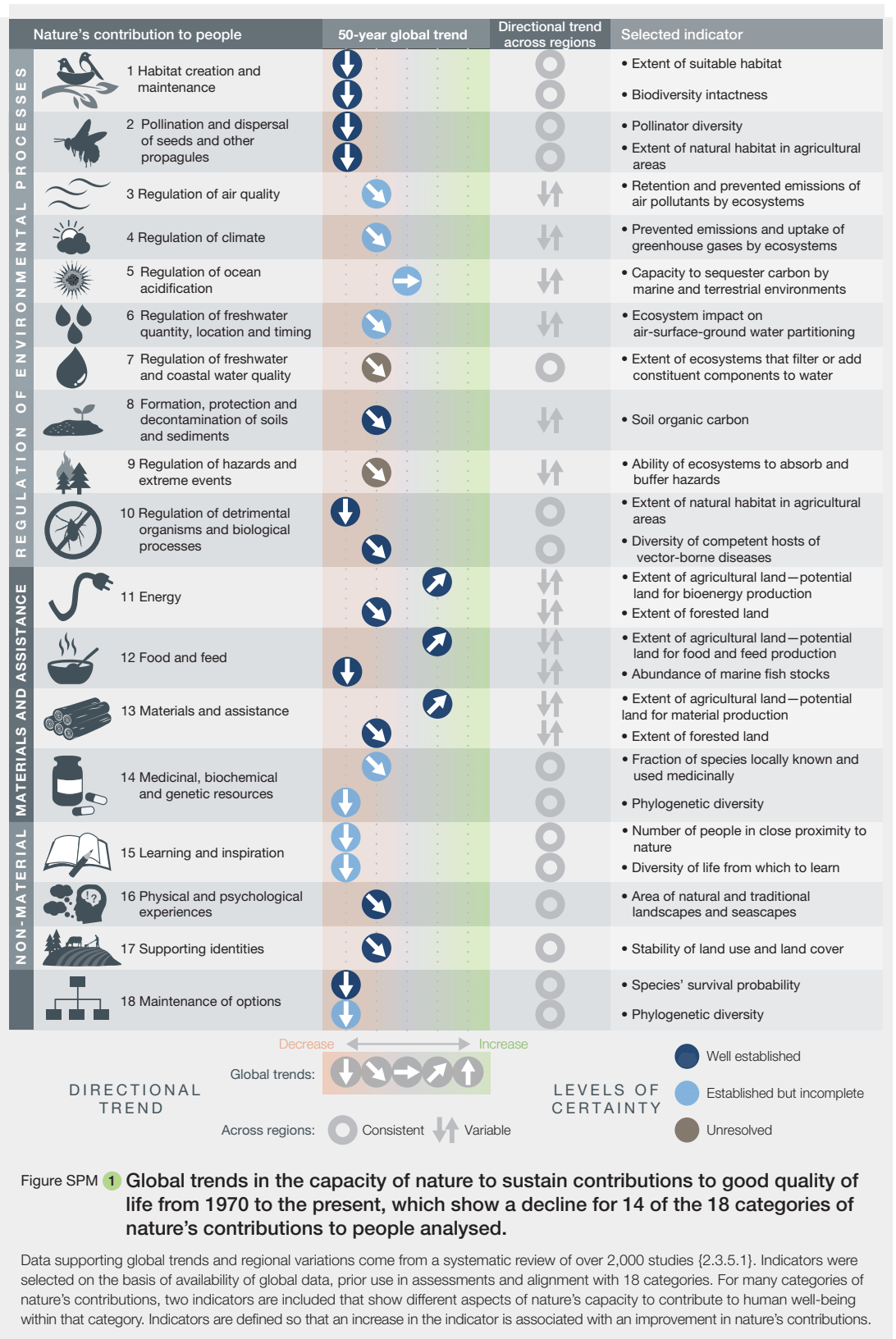
On top of this, IPBES reports a reduction in the ecosystem services that support the positive contributions humanity receives from biodiversity. Of the 18 vital contributions from biodiversity identified by IPBES, 14 are currently in decline, many of which are severely affected. These include climate regulation, soil fertility and pollination, as well as air and water quality.
A significant cause of this crisis is the insufficient incorporation of biodiversity’s value into economic and political decision-making processes. The consequences of biodiversity degradation are often ignored or inadequately addressed. Only when these values are consistently integrated into decision-making will it be possible to implement a fundamental and systemic solution to the biodiversity crisis.
The 18 ecosystem services: How they are developing
The overlooked value
A central reason, according to Carsten Rahbek, Chair of the Danish IPBES Steering Group, is that the value of biodiversity is rarely accounted for when political and economic decisions are made. The report points out that nature’s loss is often regarded as an “external effect” - something outside the balance sheet.
Carsten explains:
“Even though the causes of the biodiversity crisis are known, it remains a major challenge to include the importance of biodiversity in decision-making processes across sectors and on a scale large enough to reverse the trend. An important step is to establish a shared understanding of how these values are perceived.”
A key example is our Gross Domestic Product (GDP) - an indicator that measures economic growth but ignores the loss of nature. For decades, researchers have been working to develop a green national accounting system that incorporates nature and climate loss into the equation. Yet in practice, GDP still dominates as the benchmark for societal success.
A new understanding of prosperity
The global IPBES report Diverse Values and Valuation of Nature from 2022 marked a turning point in efforts to highlight the many dimensions of biodiversity. The report demonstrates how nature encompasses economic, ecological, cultural, and relational values - all of which, according to the Danish IPBES steering group, should be taken into account when assessing what truly creates societal value.
Because we can see that there’s a fundamental problem when this does not happen.
“In the expert group, we have tried to present possibilities for action on how these different values of biodiversity can be better integrated into decisions and planning in Danish society. Because we can see that there’s a fundamental problem when this does not happen. We must think long-term and systematically in order to include such foundational values in our decision-making processes and planning tools,” explains Mette Termansen.
Four steps towards a sustainable future
The EU and UN have set a joint objective that humanity must ‘live in harmony with nature’ by 2050, and according to Mette Termansen, there is no reason to believe that Denmark cannot meet this objective if natural values are given due consideration in political processes.
To guide policymakers, IPBES has identified four overarching areas of action:
Recognise nature’s values
The first step is to make the many dimensions of biodiversity visible - not just through research, but also via education, media, and citizen engagement. Nature’s contribution to health, the economy and quality of life must be measured and communicated on an equal footing with other societal resources.
Integrate the values into decisions
Nature must have a voice when decisions are made regarding everything from infrastructure to agriculture and investment. This requires both public and private actors to use methods that weigh nature’s value alongside financial considerations.
Reform policy and the economy
Current structures often support practices that damage nature. Subsidies, taxes, and legislation should instead promote nature conservation, sustainable innovation, and responsible resource use.
Shift societal norms
In the longer term, this transition demands a new understanding of prosperity. We must move away from measuring success solely by consumption and growth, and instead promote wellbeing, community, and harmony with nature.
Mette Termansen summarises it like this:
“An essential starting point is that biodiversity is understood and valued - and that this is reflected in society’s objectives, legislation and ultimately in our actions.”
In the expert statement from IPBES Denmark, 11 concrete measures are presented, showing how the four focus areas can be translated into Danish reality.
It concerns both better data and decision-making tools, green accounting, reforms of subsidy structures, and a new culture in which nature is regarded as an equal component of society’s foundation - not as a resource to be freely exploited.
Read more and find the 11 measures in the expert statement here:
Danish IPBES publications – IPBES in Denmark